Relationships & Attachment: Making Room for Closeness
A gentler look at reassurance, distance and the conversations that help us understand one another.
Read reflectionAnxiety & everyday life
Priyansi’s personal reflection on giving worry a name, and finding space between a feeling and an identity.

In her original personal reflection, Priyansi describes giving her anxiety a name: Pia. Instead of reading every anxious moment as proof that something was wrong with her, she could recognise that a familiar experience had arrived. The name offered her a different way to talk about it. This was her experience, not a clinical case or a promise of the same result for someone else.
There is a meaningful distinction between “I am an anxious person” and “I am noticing anxiety.” Neither phrase needs to be forbidden, but the second may leave more room for the rest of your life. You can be worried and also interested, caring, tired or amused. One feeling does not have to provide your entire introduction.
Priyansi describes worry appearing during everyday life, even over a slice of cake. Thoughts about being good enough or something going wrong could interrupt an otherwise ordinary moment. Her reflection does not present this as a character flaw. It makes visible how much private effort can exist underneath a day that looks unremarkable from the outside.
If you recognise something similar, you do not need to borrow the name Pia. You might simply notice, “There is that what-if thought again.” Naming is optional; for some people it will feel useful, and for others it may feel artificial. It is not a way to prove that a concern is imaginary or to tell yourself that you should be able to switch it off.
Another idea in the original story is sorting what is within your influence from what is not. For example, you may be able to prepare a question, decide what information to share or ask for more time. You cannot guarantee another person’s opinion or know exactly how tomorrow will unfold. This distinction is an invitation to reflection, not a demand for perfect control.
Thoughts and feelings themselves are not always things we can choose. A more realistic question might be, “Is there a practical action available to me now?” Sometimes the answer is a small task; sometimes there is nothing further to do today. Whether the worry concerns an exam, work or a personal conversation, preparation and certainty are not the same thing.
Priyansi also mentions walking, dancing and spending time outdoors among things she appreciated. These can be ordinary sources of enjoyment or a change of scene, if accessible and welcome. They are not substitutes for assessment or treatment, and nobody has failed because a walk did not make them feel better. Your needs and circumstances may be quite different from hers.
The original reflection acknowledges that anxiety still visits. Its gentler message is not that naming a feeling makes it vanish, but that a difficult feeling need not become a verdict on your worth. If anxiety is troubling you or interfering with daily life, you can seek qualified support. You do not have to make this personal exercise work, or manage everything alone, before asking for help.
A conversation, at your pace
If you would like to explore support for your own circumstances, you can ask a question or make an enquiry.
Make an enquiryKeep reading

A gentler look at reassurance, distance and the conversations that help us understand one another.
Read reflection
Exploring self-worth, approval and the parts of you that do not need to earn their place.
Read reflection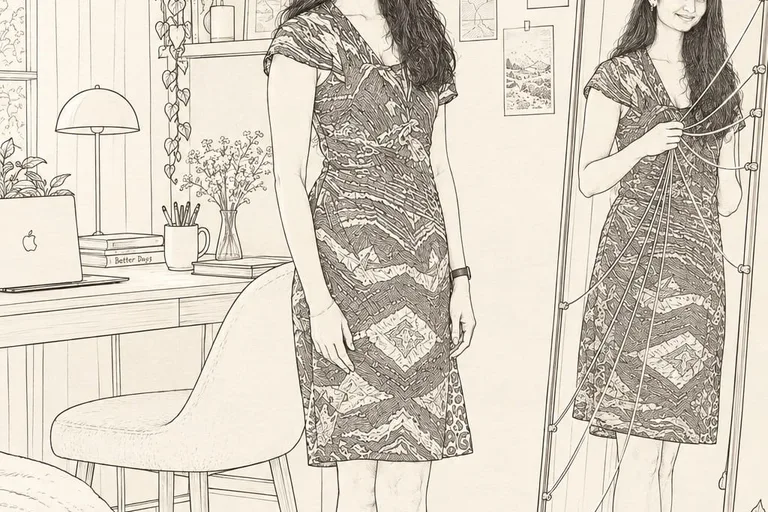
Moving from “What is wrong with me?” towards curiosity, responsibility and a different next step.
Read reflection